4.1. Mechanisms of Spatial Hearing
The human brain relies on several complementary physical and psychoacoustic cues to localize sound sources in three dimensions:
1. Interaural Time Difference (ITD)
Because our ears are separated by approximately 17 to 20 cm of skull, sound originating off the median plane arrives at the closer ear slightly earlier than at the contralateral ear.
- The maximum ITD for a source directly to one side (azimuth 90°) is approximately 0.65 to 0.7 milliseconds.
- Below ~1.5 kHz, the auditory system tracks phase differences in sound waves between the two ears with microsecond precision.
2. Interaural Level Difference (ILD)
At higher frequencies (above ~1.5 kHz), the human head acts as an acoustic obstacle, casting an “acoustic shadow.”
- Sound reaching the far ear is attenuated significantly compared to the near ear.
- High-frequency ILD differences can reach up to 20 dB or more depending on frequency and angle.
Together, ITD and ILD form the basis of Lord Rayleigh’s classic Duplex Theory of sound localization.
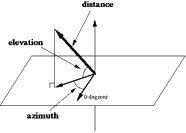
3. Spectral Pinna Cues (Cone of Confusion Resolution)
A given pair of ITD and ILD values does not define a unique point in space, but rather a geometric cone known as the Cone of Confusion. Sound sources located on this cone produce identical time and level differences between the two ears.
To resolve front from back and determine elevation:
- The folds of the outer ear (pinna), along with reflections from the shoulders and torso, create direction-dependent acoustic resonances and notches at high frequencies (above 4 kHz).
- These spectral notches serve as direction-dependent fingerprints that allow the brain to disambiguate front/back and judge source elevation.
4. Dynamic Head Motion Cues
Slight head rotations alter ITD, ILD, and spectral pinna cues in real time. The brain processes these dynamic changes to lock onto source positions and eliminate front/back reversals.