4.4. Head-Related Transfer Functions
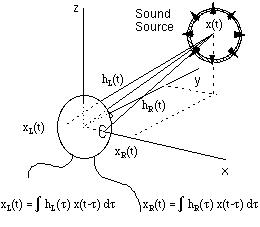
To determine the acoustic pressure that an arbitrary sound signal $x(t)$ produces at the eardrum, we require the acoustic impulse response $h(t)$ between the source position and the eardrum. This impulse response is known as the Head-Related Impulse Response (HRIR), and its Fourier transform is the Head-Related Transfer Function (HRTF). The HRTF encapsulates all physical cues used by the human auditory system to localize sound in three dimensions. Once measured for both ears, we can synthesize fully binaural 3D audio from any monaural source signal.
The HRTF is a multidimensional acoustic function depending on four variables: three spatial coordinates (azimuth, elevation, distance) and acoustic frequency. For distances beyond approximately one meter, the source is in the acoustic far field, where HRTF magnitude scales inversely with distance. Consequently, standard HRTF measurements focus on far-field variations across azimuth, elevation, and frequency.
HRTF measurements are typically performed in anechoic chambers using specialized acoustic manikins such as KEMAR (Knowles Electronics Manikin for Acoustic Research):
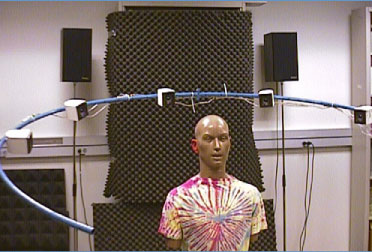
To illustrate how these functions behave across space, below is a plot of the HRIR across the horizontal plane:
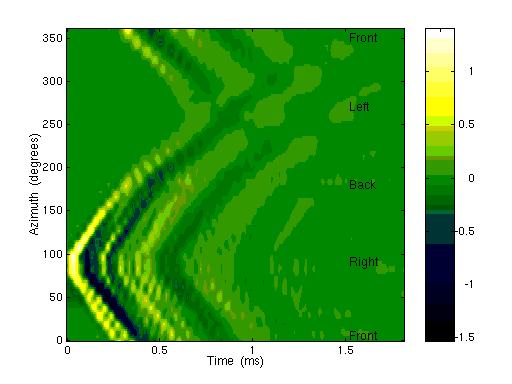
This graph displays the right-ear impulse response as azimuth varies through 360°. Brightness represents response amplitude. Notice that sound arrives earliest when the source is on the right (azimuth 90°) and arrives latest and with reduced intensity from the left (azimuth 270°). The arrival time varies smoothly along a sinusoidal curve, closely matching theoretical ITD predictions. The maximum arrival time difference between the two ears is approximately 0.7 ms.
We can also observe fine acoustic details: the rapid early reflections (dark and bright bands following the main pulse) arise from scattering off the pinna, while the reflection appearing at approximately 0.4 ms originates from the torso and shoulder.
Finally, the responses for frontal sources (0°) and rear sources (180°) show subtle but critical asymmetries caused by the forward-facing anatomy of the pinna. These subtle spectral differences allow the brain to resolve front from back.